Are Apps Designed to Be Addictive? Yes. On Purpose.
Yes. Apps are designed to be addictive. Not by accident. By teams of people who get paid to keep your thumb moving, using research your willpower was never built to beat.
That’s the whole answer. But it matters how you hold it, because the framing changes everything about what you do next.
The framing that keeps you stuck
When you call your phone habit an addiction, you point the finger at yourself. Weak. Undisciplined. Broken. Someone on Reddit caught the shift exactly: “When I call my phone use an ‘addiction,’ I blame myself. But when I look at how apps are designed, the question changes.”
The question changes because the blame was misplaced. You’re not lying on your couch failing a test of character. You’re up against a machine tuned by hundreds of engineers, designers, and data scientists whose entire job is to make you stay. As one person put it after a year of trying to quit: “I was expecting willpower to beat algorithms designed to keep me scrolling. That wasn’t a fair fight.”
It was never a fair fight. Understanding why is the first useful thing you can do.
How the addiction is actually built
None of this is conspiracy. It’s documented product design, taught in courses, bragged about in conference talks. Here are the levers.
Variable rewards. The single most powerful one. Your feed doesn’t give you something good every time — it gives you something good sometimes, on an unpredictable schedule. This is the exact mechanism that makes slot machines addictive. Your brain can’t stop pulling because it never knows which pull pays off. Every refresh is a pull.
Infinite scroll. There’s no bottom. No natural stopping point where a page ends and you decide whether to turn it. The designers removed the moment where you’d choose to continue, so you never choose — you just keep going. That’s why “one quick scroll” becomes “suddenly 40 minutes are gone.”
Autoplay and the loop. The next video starts before you’ve decided to watch it. By the time you’d think “I should stop,” the machine already answered for you.
Notifications as bait. Red dots. Buzzes. “So-and-so posted.” Each one is a hook designed to pull you back in and reset the loop. They’re not neutral alerts. They’re scheduled interruptions engineered to re-open the app.
Personalization. The algorithm learns exactly what stops your thumb and serves more of it. The longer you use it, the better it gets at holding you. You’re not fighting a static app. You’re fighting a system that’s actively studying you and adapting.
Put together, this isn’t a product that happens to be sticky. It’s a product optimized, tested, and re-tested for one number: time on device. As one blunt take on Reddit went: “Your inability to focus is not a discipline problem… It was engineered. Deliberately.”
Every lever pulling at once, engineered to keep your thumb moving.
The attention economy in one sentence
Free apps aren’t free. You’re not the customer — you’re the product being sold to advertisers, and the price is your attention. Every extra minute you scroll is inventory the app sells. So the incentive isn’t to help you use it well. The incentive is to keep you using it, full stop. A well-rested, present, phone-down you is bad for business.
Once you see that, the built-in “screen time” tools start to look strange. The company profiting from your attention also ships the dashboard telling you to use it less. Guess which one gets the real engineering budget. (More on why those timers are theater: digital wellbeing alternative.)
Why “just use willpower” is bad advice
If a habit were purely about willpower, the strongest-willed people would be immune. They’re not. Surgeons, athletes, monks — everyone’s thumb finds the feed. Willpower is a finite resource that drains across the day, and the app is patient. It doesn’t get tired. It waits for the one moment at 11pm when your discipline is spent, and it wins that moment every time.
This is also why blockers and timers fail. They ask the tired, depleted version of you to make the disciplined choice — and hand you an “off” button for when you don’t. One person’s summary of every app blocker they’d tried: “they all suck for the exact same reason: they rely on guilt.” Guilt is just willpower with worse PR. When the rule breaks, nothing happens. The app resets. There’s no cost. So you break it. For the full breakdown, see how to break phone addiction without blocking apps.
What actually works against engineered addiction
If the problem is design, the answer is design — not more effort. You don’t out-discipline a slot machine. You change the machine so it stops feeling good to pull.
That’s the idea behind Cursed Screen. It doesn’t block anything and it doesn’t count your minutes to shame you later. It attacks the one thing the addiction depends on: the phone feeling good in your hand. The longer you scroll, the worse the screen looks — hellfire oozing in from the edges, glass cracking across your feed, a red glow bleeding over the app. Nothing is blocked. You can keep scrolling. You just won’t want to.
It works because it doesn’t ask the tired version of you to win a fight. It removes the reward the design was built to deliver. The variable rewards are still there, the infinite scroll is still there — but they’re wrapped in something your eyes flinch away from. The machine keeps pulling. Your hand stops.
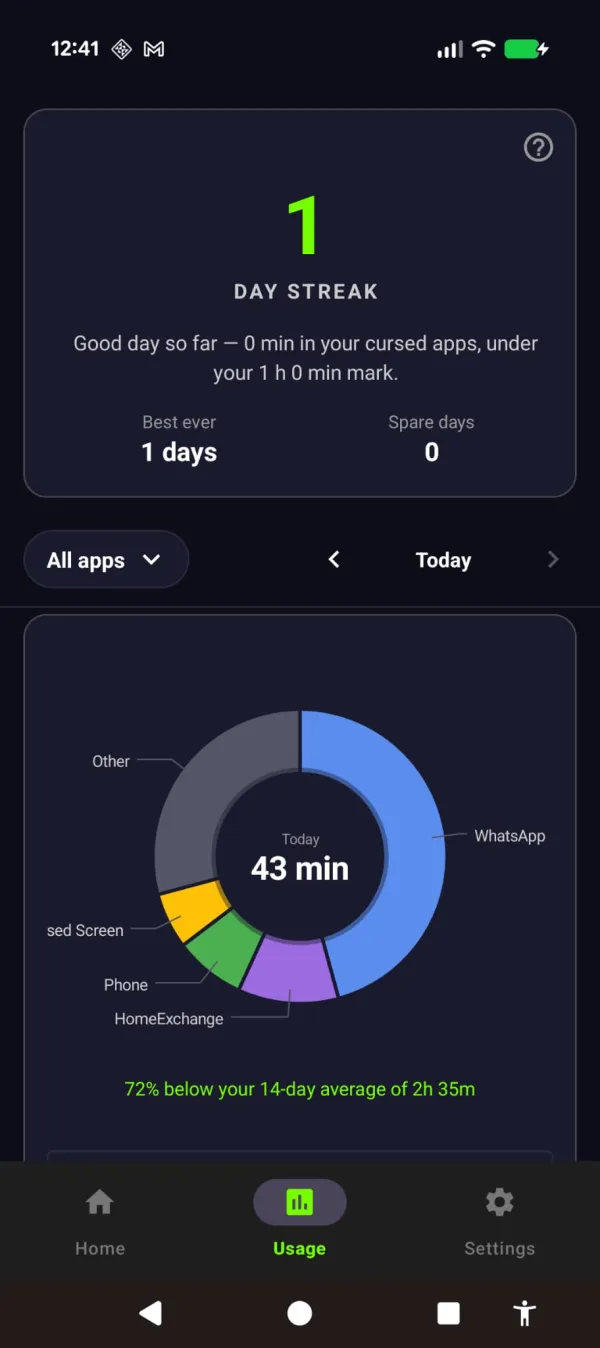
And where the app counts your minutes to sell them, Cursed Screen counts the days you spend under your limit — a streak that rewards reduction instead of shaming it, your usage shown next to it. Miss a day, resume the next. No zeroed counter, no guilt dashboard on Monday.
A streak that rewards the days you stay under your limit — reduction counted, not shamed.
The reframe that sets you free
Stop asking “why am I so weak.” Start with the real question: why is this thing so good at holding me? The answer isn’t flattering to the people who built it, but it’s freeing to you. You were never failing a character test. You were losing a rigged game.
Your phone is already cursed — engineered, deliberately, to keep you scrolling. We just help you see it. And once you can see it, it stops working on you.
Reduce your screen time — without blocking anything
Cursed Screen makes your phone progressively uglier the longer you use it. No blocking, no willpower needed — you'll want to put it down.
Get Cursed Screen on Google Play